Commercial Proposals
New Project Proposals & Commissions
If you have a new assignment or collaboration to propose, please visit our CONTACT US page.
To help us evaluate your request efficiently, please write to our Shannon Associates Team via email info@shannonassociates.com (Phone: +1 212.333.2551) with everything we should know about the project, including:
• The Timeline & Schedule
• The Budget & Usage
• The Style & Aesthetic Direction
• The Number of Images & Subject Matter
• The Project's Objectives & Goals
Our team will review your proposal and provide you with all the necessary information quickly. Many thanks for your help!
Direct Contacts & Credits
Special Projects & Fine Press
For limited editions, private commissions, or special artistic collaborations, you can reach our studio directly.
Please visit our CONTACT US page and fill out our contact form. Your request will reach us immediately. We welcome proposals for:
• Gallery exhibitions, art shows, and museum invitations
• Stock Image Licensing (to use our existing images, please visit our STOCK LICENSING page)
• Interviews and press/blog features
• International competition jury invitations
• Talks, lectures, and panel proposals (please note: we do not conduct workshops)
• Non-profit initiatives and special events
How We Work
Commissioning & Creative Process
Welcome! If you have a new project or collaboration to propose, CONTACT US!
We are always excited to evaluate fresh ideas, special fine press editions, and unique artistic commissions.
© 2000-2026 Anna and Elena Balbusso. All rights reserved. | Contact: info@balbussotwins.com
All Balbusso Twins images and content are copyrighted. No Machine Learning, No AI. You may not use our images, our name (as authors), or any content of this website (including any caption information, keywords, or other metadata associated with the content) for any machine learning and/or artificial intelligence purposes.
The artworks featured on this website cannot be used for commercial purposes by any third parties without explicit written permission from the copyright holders, Anna and Elena Balbusso Twins. Any violation of this right constitutes an infringement of copyright law and is subject to legal prosecution.
Our Artistic Philosophy
"We focus on the quality of the project, not the quantity. We continually experiment, conducting deep research and aiming for excellence with an open-minded mentality. We prefer assignments that grant us the freedom to experiment because two souls coexist within us: the artist and the designer.
To remain unpredictable, personal research is essential. We love images driven by strong ideas, conceptual synthesis, and power of expression. Our goal is to create images that arouse curiosity and evoke deep emotions while strictly avoiding stereotypes. This is our daily challenge; it is not easy, but we try!"
The Creative Process & Technique
Our unique creative process combines two core elements: rigorous graphic design and fine art painting, always shaped by a clear reference to art history.
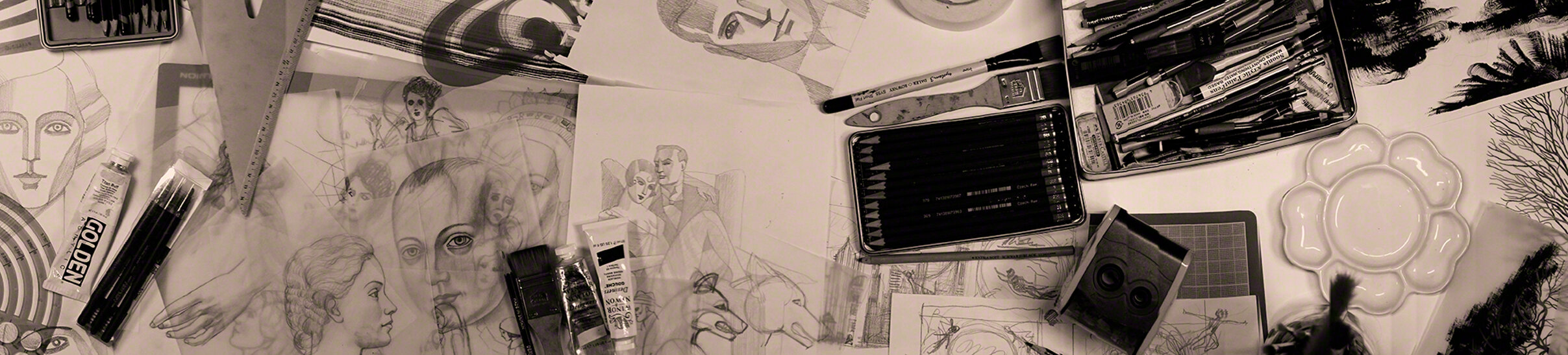
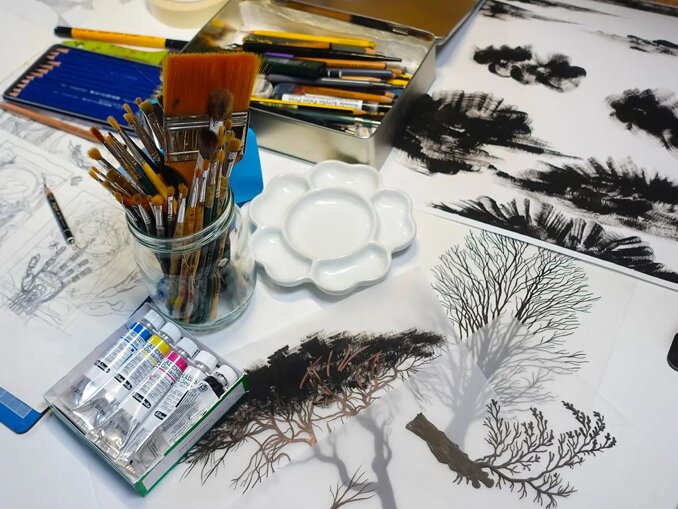
At the heart of our work is a strictly artisan approach: we do not use virtual digital brushes. Every single texture, line, and brushstroke is physically executed by hand on paper or canvas using traditional mediums. To complete our final color pieces, these authentic hand-painted elements are subsequently layered and finalized using digital tools.
For our editorial and publishing commissions, we provide highly accurate grayscale layouts and detailed sketches to art directors, ensuring a seamless and reliable professional workflow from initial concept to final execution.
Our Craftsmanship & Haute Couture Philosophy
Much like Haute Couture in fashion, we view our illustrated books and artworks as unique, unrepeatable masterpieces tailored with meticulous precision. Our creations are never serial or standardized; each project is rooted in deep artistic research and extensive study, customized to meet the specific vision of our clients. Our method is built upon a strong design culture: the image is not merely drawn, but first and foremost rigorously designed. Multidisciplinarity, continuous artistic research, versatility, and innovation form the very core of our approach. There are no shortcuts, no tricks, and no virtual filters or ready-made brushes—only intense, time-consuming hard work, profound dedication, patience, and care to consistently deliver the absolute highest quality.
Our Technical Process: Integrating Fine Art & Digital Innovation
Our technical process intimately integrates traditional fine art mediums—such as pencil, pen, watercolor, gouache, tempera, collage, and frottage—with digital tools like Adobe Photoshop®. To avoid flat, computer-generated processing, acrylic spray is manually applied to achieve sophisticated gradients characterized by a subtle, irregular analog grain.
Every texture and brushstroke is crafted by hand on paper, then scanned and layered. The color is deeply built up, mimicking the texture of a traditional fresco where the physical depth of the raw pigments can be visually perceived. By dedicating precise attention to preserving these physical pictorial layers, we guarantee a rich, tactile artwork with an effect similar to tempera or acrylic on paper.
Throughout the creative process, we conduct multiple test press runs, utilizing high-technology digital fine art printing on premium substrates to achieve the ultimate final output. This meticulous fine-tuning and digital color proofing during production ensures that our final artwork guarantees an impeccable fine art print result with a flawless and technically uncompromised execution on the page.


Creative Freedom & Tailored Solutions
In our workflow, the pictorial and graphic styles are never antithetical; instead, they maintain a constant, fluid dialogue. We demand creative freedom to choose the best path—whether pictorial or graphic—based on the specific nature of each assignment.
Our personal, distinctive choice of color is foundational to our vision. Our approach is purely artistic, free, unconventional, and non-stereotypical—yet every project remains meticulously tailored to our client's unique needs.
The Tip of the Iceberg: Art History & Concepts
The final artwork is only the tip of the iceberg of the whole creative process. You have to go very deep to get powerful images. It is important to study art history and to know the past as well as the present. In all our work, there is a clear reference to historic painters and art movements. Most projects require a strong knowledge of art history—spanning from Ancient Rome mural paintings and frescoes at Pompeii, through the Italian Renaissance and Romanticism, to Modern Art (Symbolism, Surrealism, Russian Constructivism, Italian Futurism) and Contemporary Art.
When developing Conceptual Images for editorial assignments, we study the topic, read the article, and distill the most important concepts. Our goal is to obtain an image that is as strong, concise, and centered on the topic as possible. We generally submit two to three grayscale layouts to best convey the core idea. In our style, the composition and the interlocking of light and dark build the foundation of the sketch, while color plays a crucial, defining role.

Cover art U Magazine 2023
Illustrated Books: “...it’s like making a film...”
After carefully reading a story, we select the scenes we want to illustrate, choosing compelling narrative points and balancing the total number of illustrations throughout the entire book. We always start by talking and imagining what we want the project to become.
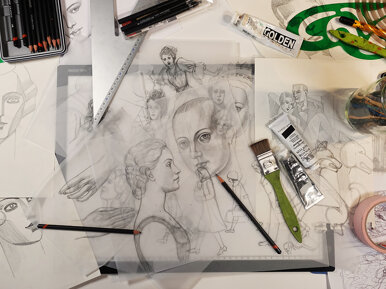
We conduct preliminary historical and iconographic research to understand how best to create the characters and settings, collecting a vast library of visual references, photos, and sketches. We develop the core ideas through very different layouts and compositions until we achieve the desired effect. We use graphite pencil on tracing paper, then digitalize our sketches to refine them. We work and rework each scene to make the art the best it can possibly be within the assignment's schedule.

The Handmaid's Tale, Folio Society 2012
Our Three-Step Workflow
Once you have discussed the assignment's details (usage, budget, copyrights contract agreement, schedule, style, and size) with our Shannon Associates team, we will work directly with you on the project through a structured three-step process:
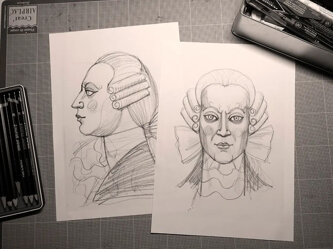
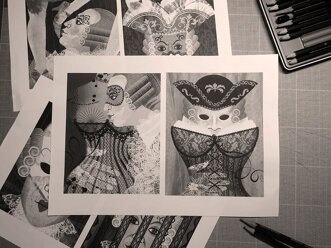
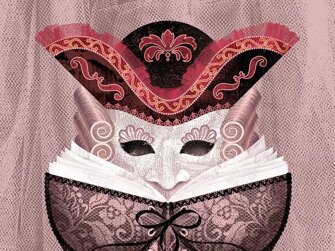
1 - Concept Development & Sketching: After receiving the brief and conducting thorough iconographic research, we create quick pencil sketches to fix our first compositional ideas. We then study all details and submit grayscale layouts very close to the final image, complete with written explanations. Minor changes can be made at this stage. Upon request, color comprehensives (color comps) can be provided during this phase to convey an idea remarkably close to the final art.
2 - Creation & Final Production: Once we receive your written approval, we proceed with the final color artwork:
Our Pictorial Style: Meticulous and time-consuming, it keeps hand-made brushstrokes and tactile material visible. It is ideally suited for extensive projects like illustrated books and luxury covers.
Our Graphic Soul: We favor our graphic designer identity for conceptual magazine assignments to tackle sensitive social themes and specific communication challenges. It is never vector, far from "fast illustration," and rooted in deep formal research.
3 - Review & Digital Delivery: After final approval, the artwork is delivered in high-resolution digital formats (such as TIFF, EPS, or JPEG). It is a rich, flattened image (not a vector file) that can be rapidly and securely transferred via WeTransfer or Dropbox download links for a flawless print execution.